

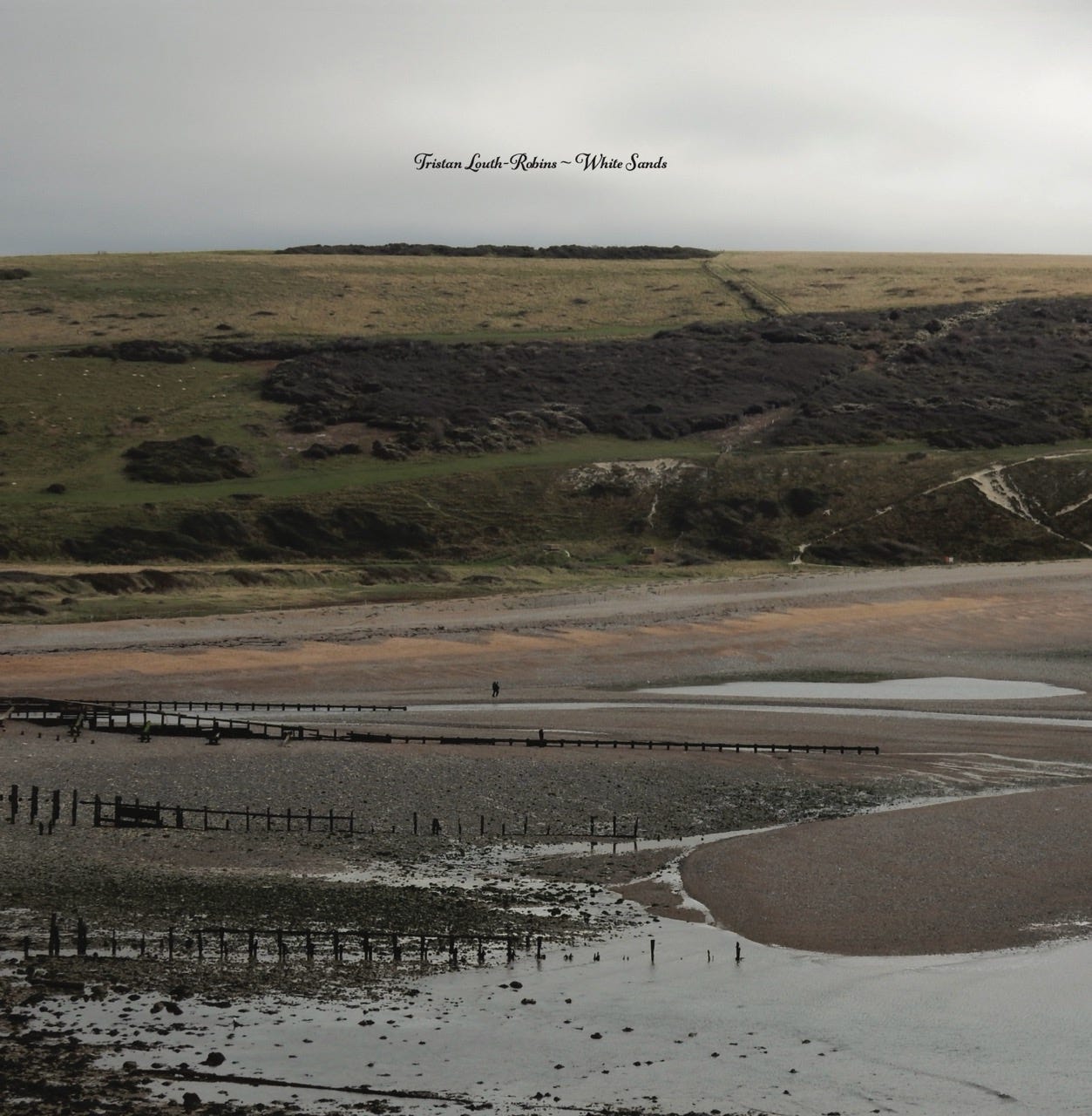
White Sands
Notes on my new album

“Later, listening back to the recording, he was surprised to find how the sound of the gulls and wind, the slap of waves, evoked not the grim reality of the crossing but the romantic ideal of a sun soaked cruise.” - Geoff Dyer, The Search
Compared to my last couple of albums White Sands is somewhat of a departure in style. This album has a heavier emphasis on conventional instrumentation and harmonic structure which is something that I have actively avoided in the past, employing all manner of strategies to purposefully obscure the semblance of a nice-sounding chord.
The artefacts of human presence have also inadvertently made their way into the tracks of this album. Voices carried within rooms and exterior spaces; footsteps squeaked on tiles and squelched in the earth; things were being dropped, clothing rustled, vehicles passed or instruments were being played. Their appearance in the material hadn’t come about through deliberate intent on my part, but there was certainly something at play in my subconscious that gradually allowed these presences back into the mix. Like my softening to harmonic structure, this may not be a coincidence, but a result of some deep rethinking about my place within the musical, art and wider world. After a lot of self contemplation and the resulting intense need for change and fresh perspectives, a holiday was well overdue. All of the field recordings that feature on White Sands were made during this escape from monotony, on a trip that traversed the lands of Scotland, England, Belgium and Germany.
But before I went on holiday in late 2025, I reread two books by Geoff Dyer - The Search (1993) and White Sands (2016). A cursory scan of this album’s title and tracklist will uncover a few connections to the author and these books and that’s entirely intentional. The latter book, White Sands obviously informed this album’s title and the book’s general theme soaked into my thoughts prior to the holiday and subsequently informed how the album would develop upon my return. Dyer states in the introduction of White Sands that he’s taken certain creative liberties in his telling of recollected events. Such an approach leans heavily into the role of the unreliable narrator and interrogates the fallibility of memory, but above all Dyer is interested in what happens when we encounter places and how we are partial to colour or exaggerate our impressions. He points out that we’re especially prone to do this when the place in question is one that we have actively sought out. What happens when a place doesn’t meet our expectations? What makes a place a place?
Accompanying Dyer’s White Sands is the entirely fictional ramble of The Search, which can be read as a clear homage to Italo Calvino (think Invisible Cities meets On A Winter’s Night A Traveller.) Part mystery and road movie set to text, it starts out conventionally enough before unfurling into a highly liminal and disorienting tale. The protagonist’s perceptions warp, landscapes and structures shift abruptly, and at several points the reader can be left wondering if the character is possibly inhabiting a photograph, a film, a tape recording or the backdrop of a painting by Giorgio de Chirico. Taken together, what I feel The Search shares with White Sands is a fascinating interrogation of how we perceive and make sense of the world and reconcile this comprehension against what we knew previously and what we know now.
The questions of place and its meaning posed by Dyer in White Sands as well as the slippery grasp of reality running through The Search lingered over several moments - both recorded and unrecorded - that informed the creation of this album. There was the twenty minutes of simply waiting for my partner in an upper foyer of The Barbican. At once thrilled that I was finally here in this Brutalist wonderland, I was unable to do much at that moment other than exist in dead time, sitting between two antiquated elevators and passively observing their judder and squeak in stereophonic (dis)harmony as they periodically expelled people on either side of the highly reverberant foyer. This formed the basis of the track “Space Remains”. There was a strange visit to a remote site in the Scottish Highlands which inspired the track “Stones That Walk”, where graves written in Scots Gaelic sat within the ruin of a 14th Century church. With only myself and my partner there, crypts overgrown with vegetation took on intangible, yet slightly ominous meanings, insects swarmed in tight clusters, and an oncoming storm whirled threateningly around the bent trees overhead. There was my solitary walk up a narrow country road and hearing from behind the thunderous gallop of several clydesdales, turning just in time to catch a glimpse of them finishing their run from one end of a paddock to the other (“Geoff In Easter Galcantray”.) There was the chance encounter with a busker in Edinburgh, who was playing their saxophone beneath the arch of a huge bridge, using these acoustic properties to project the tones of their instrument further afield. The busker, Theo and his saxophone feature as the centrepiece on the track, “The Search”. There was the unexpected glorious bleakness of a few days in East Sussex (“The Chalk Drift”.) We had walked through tiny villages, passed through the knackered and neglected seaside town of Newhaven, skirted the edges of Monk’s House and walked along the River Ouse where Virginia Woolf died with stones in her pockets. On the last morning as I sat in Lewes station waiting for our train back to London, I found myself suddenly in tears. It was as if a collective grief or damp psychic weight of this environment had gradually been soaking into my consciousness and finally overcome me.
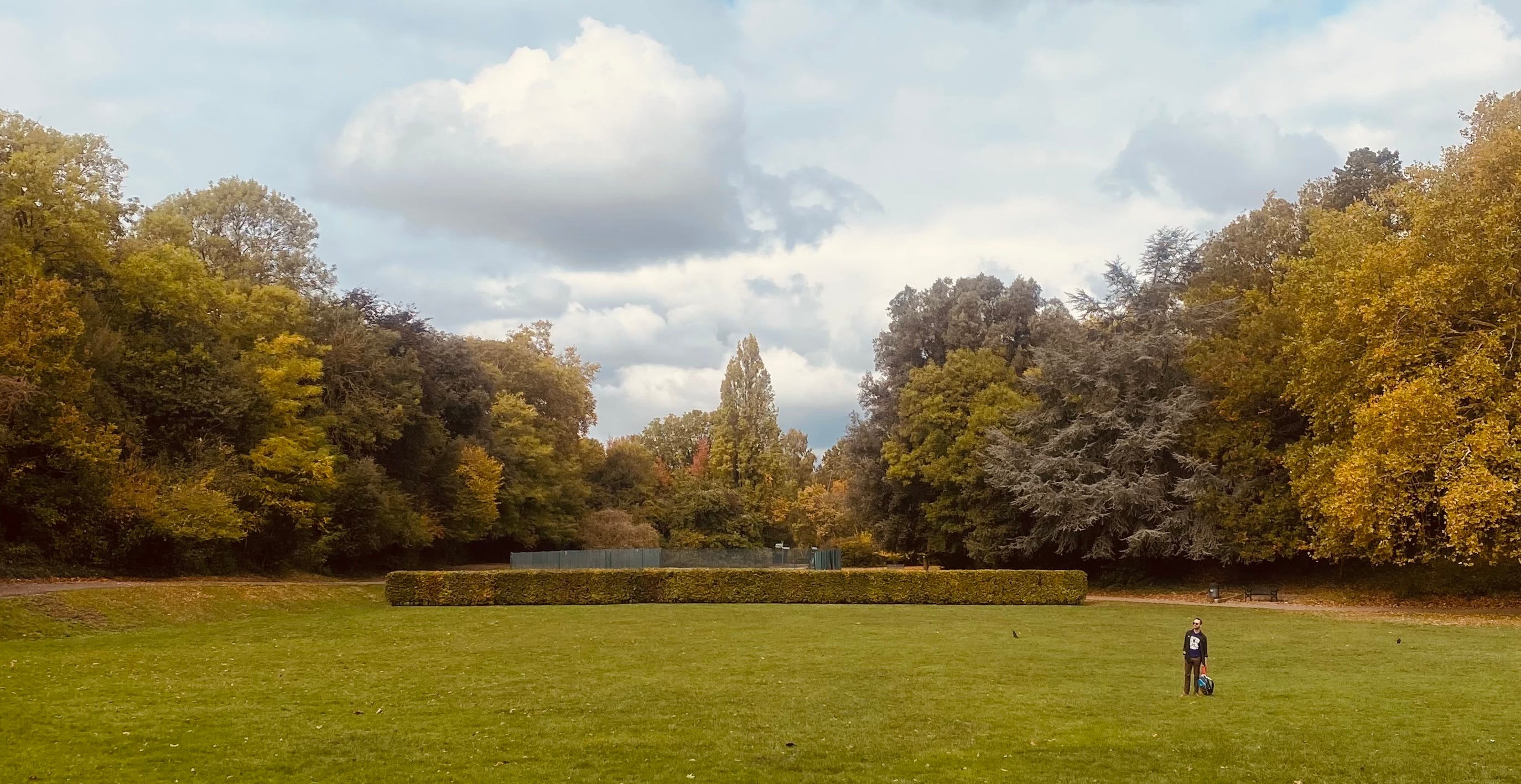
But this perennial question of what a place meant presented itself perhaps most potently when we visited Maryon Park in London. This was a site that I had been fascinated with ever since I saw Michelangelo Antononi’s 1966 film Blow Up twenty years prior. Aside from this park, I had never had the inclination to visit a place from a film or television show and now I was here; caught in a mental friction, between Blow Up’s fictitious representation of the park and its in-situ reality. Attempting to further satisfy my expectations, by applying the guiding environmental parameters of the park as they had appeared in the film, the conditions were appropriate. It was overcast (as I’d hoped it would be) with not many people around. A gentle breeze allowed the trees to sound familiar, albeit not in a monophonic profile as heard in the film. Here I could hear the oak, ash and poplars all around, melding with the roar of distant traffic and the redevelopment of a neighbouring residential area. Heard in surround sound with a greater transparency than that afforded in the film, collectively it was almost too overwhelming and I couldn’t quite believe I was here. It didn’t feel quite real and it was as though my prior impressions and expectations were smashing and exploding against the dizzying array of present thoughts whipping around my head. It felt akin to being comfortably stoned, but not entirely sure of where the hell you were. A photo taken by my partner captures me standing at a distance on park’s grassy expanse looking slightly uncertain and adrift, much as David Hemmings’ character did at the end of Blow Up, before he slowly dissolved away, leaving a backdrop of grass in his wake.
TLR, May 2026
White Sands is to be released on De La Catessen Records. Preorders are available from 9th May 2026.
Space Remains
The Chalk Drift
Stones That Walk
Geoff In Easter Galcantray
The Search
Blackest Waters
Maryon Dreaming
Recorded and composed from November 2024 to April 2025
Field recordings were in and around Edinburgh, Doune, Burn O’ Vat, The Baravan Lifting Stone (Achindown), London, Piddinghoe, Newhaven, Bruxelles and Heppenheim.
Tristan Louth-Robins: guitars, bass, piano, keyboards, synthesiser, percussion, textures, field recordings.
Theo Jobst: saxophone (”The Search”)
Mixed by Tristan Louth-Robins
Mastered by Kenneth Mitchell (Cloud Forest Mastering)
De La Catessen Records, 2026